Sciton released a new laser today. It’s called Super MOXI, and if you’ve been following skin resurfacing at all, the name gives away most of the story. It’s a bigger, faster version of MOXI, the gentle 1927nm laser that a lot of people know as the “no downtime” treatment.
Here’s what actually changed, what it means for patients, and an honest look at how it compares to what we already run at our Palm Harbor office.
First, a refresher on what MOXI is
MOXI is a non-ablative fractional laser that runs at 1927nm. That wavelength is absorbed by water in the skin, and it’s very good at one specific job: lifting unwanted pigment and brightening dull, sun-damaged skin without wounding the surface. It works shallow, reaching roughly 100 to 200 microns, which is the epidermis and the very top of the dermis.
Because it doesn’t ablate tissue, recovery is mild. Most people look a little pink and sandpapery for a couple of days, then they peel lightly and move on. That’s why MOXI became the entry point for so many patients. It’s the treatment you can do in your thirties before you have real damage, and the one that’s safe enough to run on darker skin types when a more aggressive laser wouldn’t be.
The tradeoff has always been coverage. A standard MOXI pass covers a modest area, and a typical face session runs 8 to 10 minutes depending on how many passes you stack. Treating a full back or both arms meant a long appointment.
What Super MOXI changes
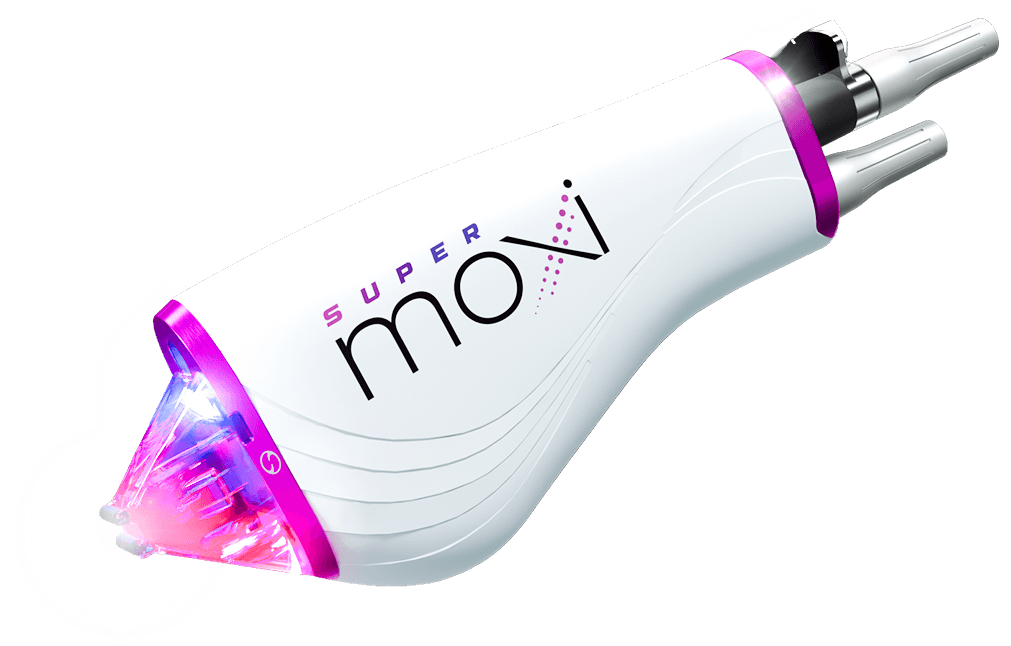
Sciton’s announcement focuses on throughput. Three things are new:
Twin beams. The handpiece now puts down twice as many energy beams per pass. Sciton says this cuts treatment time up to half compared to traditional MOXI.
A 16W diode. More power on tap. Notably, Sciton frames this as supporting both higher density and lower energy settings, so the point isn’t to hit harder. It’s to cover more ground with finer control.
HD Delivery. The branded name for the delivery system that makes the above work together.
Put together, the pitch is full-body treatment. Sciton lists face, neck, chest, hands, arms, back, and legs as treatment areas, and the phrase they’re using is “head-to-toe skin revitalization.” Areas that were technically treatable but impractical to schedule now fit in a reasonable appointment.
Super MOXI runs on the portable mJOULE platform and on JOULE X. It also opens new ScitonStaX combinations, meaning it can be layered with BBL HEROic, ClearSilk, or ProFractional in one visit, or used after a corrective treatment like Contour TRL.
What Super MOXI does not change
This part matters, and the marketing won’t emphasize it.
Sciton has not published a wavelength spec for Super MOXI, but MOXI has always been a 1927nm platform and nothing in the announcement suggests that changed. Same wavelength, same target, same biology. It is not a new kind of treatment, and it will not do something to your pigment that MOXI couldn’t do. What it does is deliver that treatment faster and over more real estate.
So if you were considering MOXI for your face, Super MOXI is a scheduling upgrade, not a results upgrade. If you were considering it for your back, arms, and legs, it’s a genuine unlock.
How this compares to our HALO TRIBRID
Now the honest part, because a fair number of people are going to read about Super MOXI and ask us whether we have it.
We do not have Super MOXI. It launched today. What we run is HALO TRIBRID on Sciton’s JOULE platform, and there’s real overlap worth explaining.
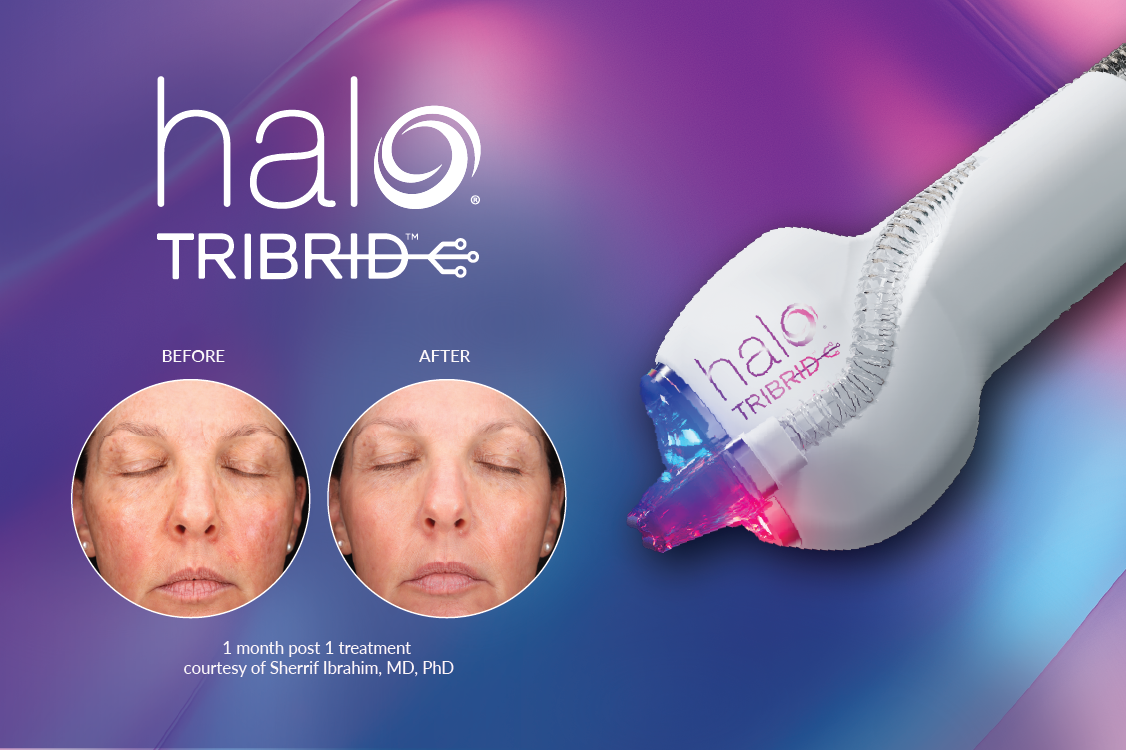
TRIBRID fires three independently controlled wavelengths in one session:
- 2940nm for controlled surface ablation, tunable from 20 to 150 microns
- 1927nm, the MOXI wavelength, for pigment and brightness
- 1470nm for deep dermal remodeling, reaching 300 to 700 microns
That middle line is the one to notice. The MOXI wavelength is built into TRIBRID, and on TRIBRID it runs with what Sciton describes as twice the available adjustable energy, 10 to 40 mJ. A standard MOXI runs roughly 5 to 20 mJ. So when we treat pigment on TRIBRID, we’re working with roughly double the energy ceiling of a conventional MOXI, and we’re stacking two other wavelengths on top of it in the same appointment.
Here’s the fair comparison:
| Super MOXI | HALO TRIBRID (what we run) | |
|---|---|---|
| Wavelengths | 1927nm | 2940nm + 1927nm + 1470nm |
| 1927nm energy | Not published | 10 to 40 mJ |
| Main advantage | Speed and large-area coverage | Depth and layered correction in one session |
| Best for | Full body, maintenance, prevention | Face, neck, chest correction |
| Skin types | All | Fitzpatrick I through VI |
One clarification, since we get this question in a technical form: Sciton has not published a wattage figure for TRIBRID’s 1927nm channel. We can tell you TRIBRID’s MOXI wavelength carries double the adjustable energy. We can’t tell you it has Super MOXI’s twin-beam hardware, because Sciton hasn’t said so, and we’re not going to guess about equipment in either direction.
So which one would you actually want
It depends entirely on what you’re trying to fix.
If your concern is texture, scarring, deeper lines, or sun damage that has been building for twenty years on your face, neck, and chest, layered correction wins. Three wavelengths in one session reach three different depths, and that’s work a single 1927nm pass cannot do no matter how fast it runs.
If your concern is broad, even, preventive brightening across large areas of the body, or you want frequent low-intensity maintenance, Super MOXI’s speed is a real advantage and we’d tell you so.
Most patients we see fall into the first group, which is why we invested in TRIBRID. That said, we watch what Sciton releases closely, and we’re evaluating Super MOXI. If it earns a place next to what we already have, we’ll add it, and we’ll say so here.
Come talk it through
The right laser is a function of your skin, your pigment, your history, and how much downtime your calendar can absorb. We’d rather look at your skin and tell you honestly what will move the needle than sell you a treatment because the device is new.
Consultations are complimentary and can be done virtually. Book online or call us at (727) 274-1972.
Want the deeper breakdown? Read our full guide to Sciton TRIBRID, or compare the options in MOXI vs HALO vs TRIBRID.
Sources: Sciton Inc. press release, September 1, 2026; supermoxi.com; sciton.com/halo-tribrid. MOXI, Super MOXI, HALO, TRIBRID, BBL HEROic, ClearSilk, ProFractional, Contour TRL, mJOULE, and JOULE X are trademarks of Sciton, Inc.