Subcutaneous and intramuscular technique, step by step, from the physician-led TRT program at Olympia Aesthetics & Wellness in Palm Harbor.
Reviewed by Oliver Morris, DO · Medical Director
If you have just started testosterone replacement therapy, the first injection is the part everyone worries about. Almost every patient tells us afterward that it was easier than they built it up to be in their head. The needle is small, the injection takes about ten seconds, and within two or three weeks it stops being an event and becomes a Sunday morning habit.
This guide covers both routes we use: subcutaneous, which goes into the fat layer just under the skin, and intramuscular, which goes deeper into muscle. We lean subcutaneous for most patients now, and the section below explains why.
Before you use this guide: it is written for patients who already have a prescription and who have been shown the technique in person. We teach every TRT patient how to inject at their visit, and we hand you this page as a reference for when you are standing at your own kitchen counter. Do not start injecting from a web page alone, and do not use testosterone that was not prescribed to you. Your dose, your ester, your needle size, and your schedule are specific to your labs.

SubQ Pro, our free TRT log app, tracks your injections, sites, and schedule between visits.
For decades, testosterone meant a big needle in the glute every one or two weeks. That is still a perfectly valid way to do it, and some patients prefer it. But the field has moved, and most of our patients now inject subcutaneously.
The practical reasons are easy to understand. A subcutaneous injection uses a much shorter, thinner needle, it goes into a layer with fewer pain receptors than muscle, and you can reach the sites yourself without twisting around to find your own hip. Patients who dreaded injections almost always do better on this route.
There is also a pharmacologic argument. Large intramuscular doses given every couple of weeks produce a high peak in the days after the shot and a low trough before the next one, and that swing is what patients feel as a roller coaster in mood and energy. Smaller, more frequent subcutaneous doses flatten that curve. When researchers compared intramuscular testosterone cypionate against a subcutaneous testosterone enanthate autoinjector, the subcutaneous group ran a much tighter peak-to-trough ratio and showed lower post-treatment hematocrit and estradiol, two of the markers we watch most closely on TRT.
Worth knowing for context: the FDA has approved a testosterone enanthate autoinjector specifically for weekly subcutaneous use in the abdomen. Testosterone cypionate, the ester most commonly dispensed in the United States, is labeled for intramuscular use, so giving cypionate subcutaneously is an off-label route. It is widely used, it is well supported in the literature, and it is a decision your prescriber makes with you rather than something you switch on your own.
| Subcutaneous | Intramuscular | |
|---|---|---|
| Where it goes | Fat layer under the skin | Muscle, below the fat |
| Typical needle | 27 to 30 gauge, 1/2 inch | 23 to 25 gauge, 1 to 1.5 inch |
| Volume per shot | Up to about 0.5 mL comfortably | 1 mL or more tolerated |
| Usual frequency | Once or twice weekly | Weekly to every two weeks |
| Angle | 45 to 90 degrees into a pinched fold | 90 degrees, straight in |
| Best for | Most patients, needle-averse patients, steadier levels | Larger volumes, patients who prefer fewer injections |
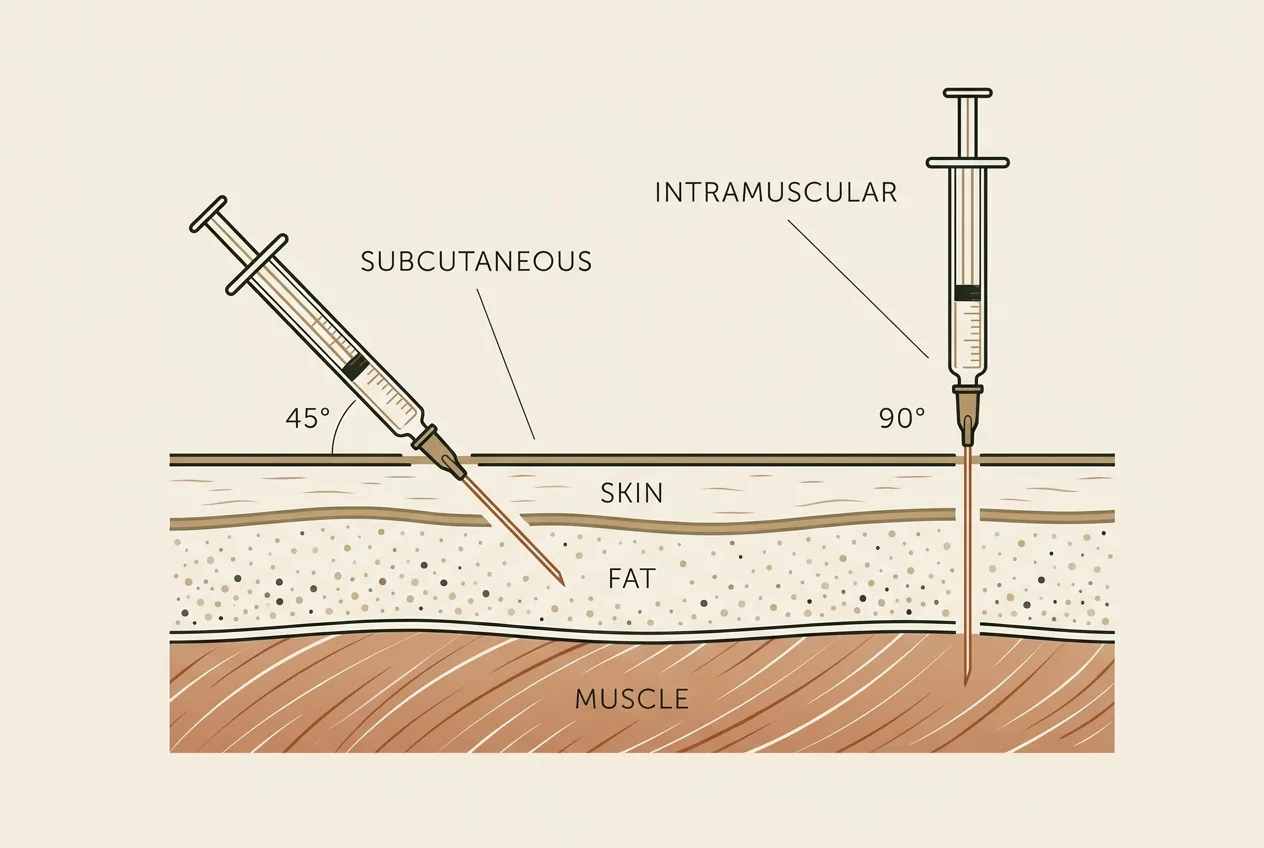
One thing that surprises people: switching from intramuscular to subcutaneous does not usually mean changing your weekly total. It often means taking the same weekly amount and splitting it into two smaller shots. Any change to your dose comes from your labs, not from the route.
Wash your hands with soap and water first. That single step prevents more problems than anything else on this list.
This part is the same whichever route you use.
About air bubbles: a tiny bubble in a subcutaneous or intramuscular injection is not dangerous. The air-embolism warnings you have read about apply to injections into a vein, which is not what you are doing. Clear the bubbles because they throw off your dose accuracy, not because a small one will hurt you.
Injecting the same square inch for months builds up firm, lumpy tissue that absorbs unpredictably. Rotate deliberately. Left side one week, right side the next, and move an inch or two within the zone each time. A note in your phone beats trying to remember.
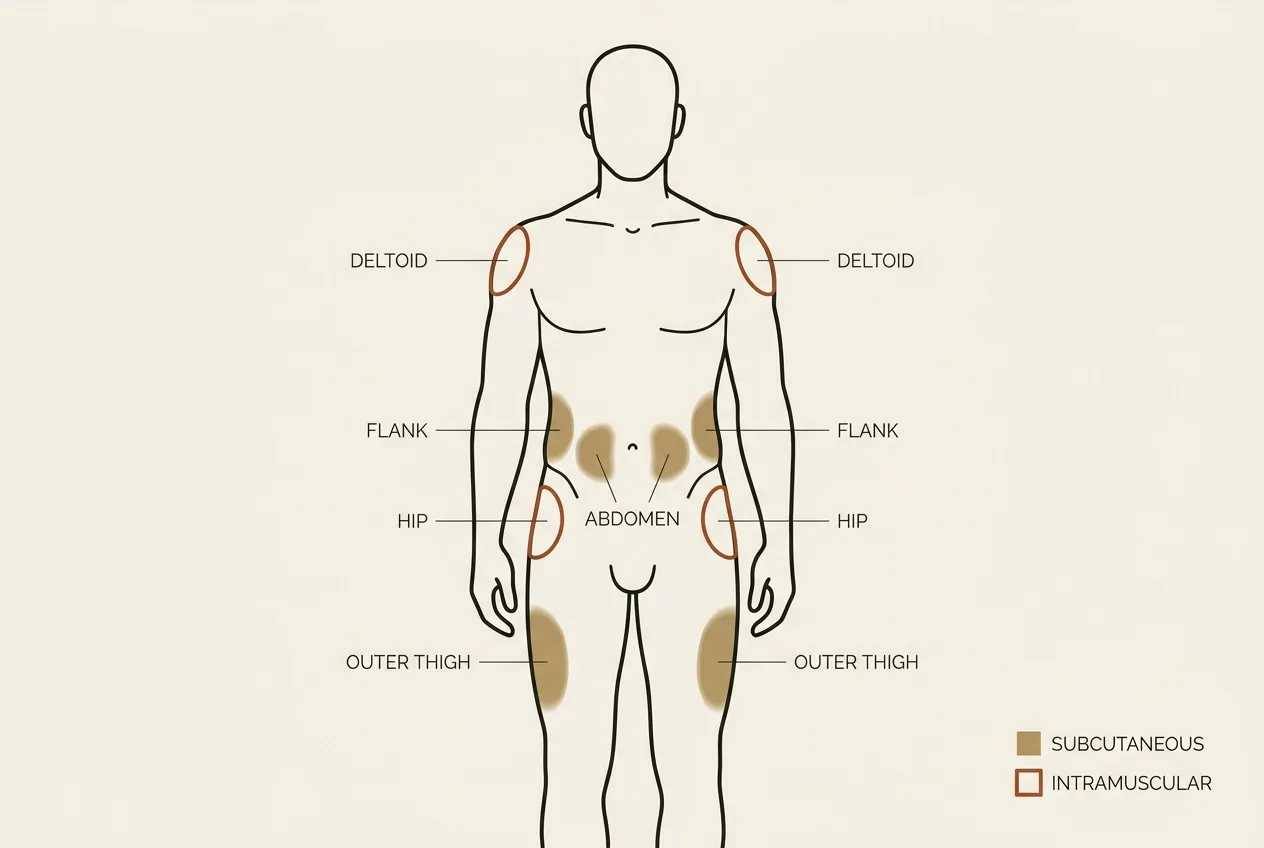
If you also run a peptide protocol, remember that those injections need their own rotation plan. Do not stack a peptide shot on top of the spot you used for testosterone the same morning.
A little redness, a small bump, or mild tenderness for a day is normal. Subcutaneous injections sometimes leave a slightly firm spot that softens over a few days. Intramuscular injections can leave a deep ache that peaks a day or two later, most often in the deltoid.
Used needles go in an FDA-cleared sharps container, and full containers go to a household hazardous waste collection site or a pharmacy take-back program rather than your curbside bin. In Pinellas and Pasco County, the county solid waste programs both accept them. Ask us at a follow-up if you are not sure where your nearest drop-off is.
| What happened | What to do |
|---|---|
| A drop of blood at the site | Normal. Light pressure for 30 seconds. You nicked a tiny capillary. |
| Oil leaked back out | You lost a very small amount. Do not redose. Next time inject a little slower and pause before withdrawing. |
| It stung going in | Usually wet alcohol, cold oil, or a reused needle. Let the skin dry, warm the vial, always swap needles. |
| A firm lump that lingers | Rotate away from it and let it resolve. Tell us if it is still there in two weeks. |
| You hit a nerve and felt a zing | Withdraw and pick a different spot. Mention it at your next visit so we can review your landmarks. |
| You are not sure you got the full dose | Do not guess and do not repeat it. Record what happened and call us. |
Call us at (727) 274-1972 if you have spreading redness or warmth, a site that gets more painful after day two instead of less, drainage or pus, a fever, or a hard swollen area that keeps growing. Those point to an infection rather than ordinary post-injection soreness. If you develop chest pain, trouble breathing, or one-sided leg swelling, treat that as an emergency and call 911.
Yes. Both routes get testosterone into your bloodstream and both raise levels reliably. The difference is the shape of the curve rather than whether it works. Subcutaneous dosing, especially split into smaller weekly or twice-weekly injections, produces steadier levels with a smaller gap between peak and trough. In head-to-head comparisons against intramuscular cypionate, a subcutaneous enanthate autoinjector showed lower post-treatment hematocrit and estradiol, which are two of the markers that most often force a dose change. What matters in the end is your follow-up labs, and we check those at week six and then quarterly.
For subcutaneous injection, most patients use a 27 to 30 gauge needle that is half an inch long, or a 0.5 mL insulin-style syringe. For intramuscular injection, 23 to 25 gauge and 1 inch to 1.5 inches, with the longer needle needed for the hip in larger patients. Separately, use a wider 18 to 21 gauge needle just to draw the oil out of the vial, then switch before injecting. Your prescription and your body composition determine the exact combination, so use what we dispensed rather than what a forum recommends.
For most patients it is the lower abdomen, subcutaneously, at least two inches from the navel. The fat layer there has fewer pain receptors than muscle, the needle is short and thin, and you can see exactly what you are doing without contorting. The flank is a close second. Among intramuscular sites, the ventrogluteal site at the side of the hip is usually more comfortable than the deltoid, which is the site most likely to leave you with a deep ache the next day.
That comes from your labs and your ester, not from a rule of thumb. Weekly is common, and twice weekly is increasingly common on the subcutaneous route because splitting the dose smooths out the peaks and keeps the volume per shot small. Longer intervals of every two weeks are still used with intramuscular cypionate. Oliver sets your interval after reviewing your baseline panel, then adjusts it based on your week-six labs.
For subcutaneous injections, no. For intramuscular injections the guidance has shifted, and aspiration is no longer considered routinely necessary, though plenty of clinicians still do it briefly for oil-based testosterone in the gluteal area. Follow whichever approach we taught you at your visit. The one part that is not optional: if you ever draw blood back into the syringe, stop, throw that dose away, and start fresh at a different site.
Talk to us first. It is usually a straightforward change and often means taking the same weekly total split into two smaller shots, but it also changes your needle, your sites, and sometimes your monitoring. Testosterone cypionate is labeled for intramuscular use, so subcutaneous cypionate is an off-label route that should be a documented decision between you and your prescriber rather than something you start on your own.
Free iPhone app from Dr. Oliver Morris
SubQ Pro: Peptide & TRT Log
Log your injections, sites, and schedule, so your week-six follow-up starts from a record instead of a guess. Free to download, with optional paid features.
The app handles tracking only. Your dose, interval, and route come from your prescriber.
We teach injection technique in person at every TRT start, and we will happily walk through it again at a follow-up. If you are considering testosterone therapy and want a real workup rather than an online questionnaire, start with a consultation.
Book a consultation
Physician-managed hormone care in Palm Harbor. Call (727) 274-1972.
Medically reviewed
Reviewed by Oliver Morris, DO, Medical Director at Olympia Aesthetics & Wellness, 33295 US Hwy 19 N, Suite 109, Palm Harbor, FL 34684. Last reviewed July 2026. This guide is patient education for people already prescribed testosterone therapy under medical supervision. It is not a recommendation to obtain or use testosterone without a prescription, and it does not replace the in-person training and individualized dosing plan that come with our program.
References: XYOSTED (testosterone enanthate) prescribing information, DailyMed. Amory JK et al., pharmacokinetics of testosterone formulations, and the comparative outcomes literature on intramuscular testosterone cypionate versus subcutaneous testosterone enanthate autoinjectors, indexed at PubMed.