Attaching a needle, dialing a dose, and the unit-versus-milligram arithmetic that causes more dosing errors than anything else.
Reviewed by Oliver Morris, DO · Medical Director
A pen looks intimidating for about ninety seconds. Then you use it once and it becomes the easiest part of the whole routine, because the pen does the measuring for you and there is nothing to draw up.
Pen or vial? Depending on the protocol, peptides can come in a reusable pen like the one in the videos below, or as a vial you draw up with a syringe. Your provider will tell you which one you have. If yours is a vial, the technique you want is in our injection guide instead.
Read this first: this page is written for people already under a provider’s supervision who have been shown the technique in person. It is a reference for when you are standing at your own counter at six in the morning, not a substitute for being taught. Doses are set by your prescriber for your specific cartridge. Do not use this page to work out a dose on your own, and do not inject anything that was not prescribed to you.

SubQ Pro, our free app, logs each dose and injection site as you go, so rotation takes care of itself.
A pen is a syringe with a gearbox. Instead of pulling liquid into a barrel and lining it up against printed marks, you turn a dial, an internal screw advances a measured amount, and the plunger pushes exactly that much out through a very short needle. That is the whole trick.
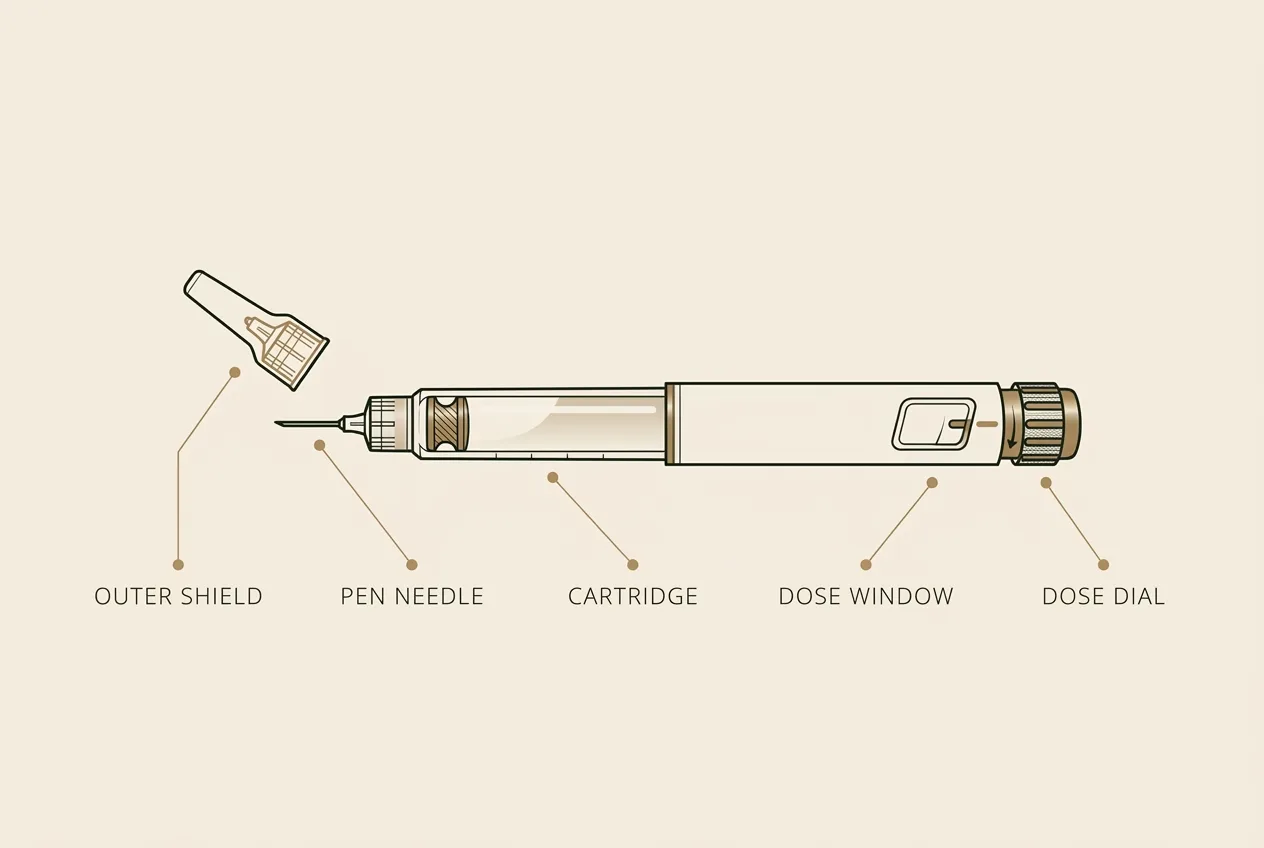
Two kinds show up. Some are prefilled single-product pens where the dial is marked in the finished dose. Others are reusable pens holding a replaceable cartridge, and those read in insulin-style units. Which one you have changes how you read the dial, so confirm it before your first dose rather than assuming.
| Pen | Vial and syringe | |
|---|---|---|
| Measuring | Mechanical, by dial clicks | Visual, against printed lines |
| Needle | 4 to 8 mm pen needle, attached fresh each dose | Fixed on the syringe, commonly 1/2 inch |
| Best at | Repeatability and small doses | Flexibility and odd volumes |
| Fails at | Flexibility when a dose changes | Consistency dose to dose |
The real advantage of a pen is not comfort, though it usually is more comfortable. It is that dose forty looks exactly like dose one. With a syringe, small reading errors drift across a long cycle. A pen does not drift.
This setup happens before every dose, without exception. Rushing it is the most common reason something goes wrong later in the routine.
This is the single biggest source of dosing errors with pens, and it is worth reading twice. On a reusable cartridge pen, the dial is not measuring drug. It is measuring volume. One unit on an insulin-style scale is 0.01 mL, and that stays true no matter what is in the cartridge. The pen has no idea whether the liquid inside it is strong or weak.
So the same 10 on the dial can be a trivial dose or a serious one, depending entirely on how the vial was mixed. Your prescriber does this arithmetic and hands you a number of units. Here is the math behind that number so it is not a black box.
| Step | Where it comes from | Worked example |
|---|---|---|
| 1. Vial strength in micrograms | Printed on the vial, converted | 10 mg = 10,000 mcg |
| 2. Diluent added | Written on the label when it was mixed | 2 mL of bacteriostatic water |
| 3. Concentration | Step 1 divided by step 2 | 5,000 mcg per mL |
| 4. What one unit holds | Step 3 divided by 100 | 50 mcg per unit |
| 5. Units to dial | Prescribed dose divided by step 4 | 250 mcg ÷ 50 = 5 units |
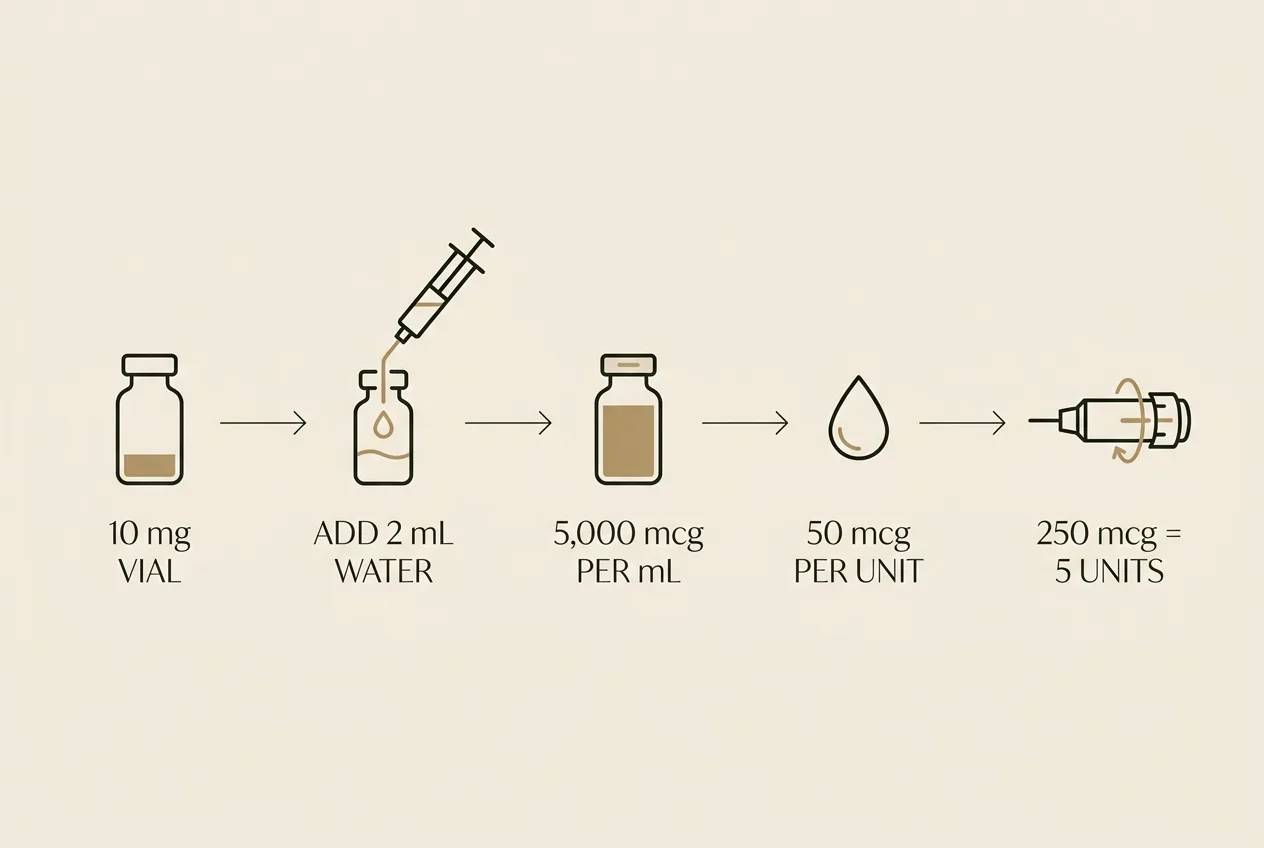
Change one input and the answer moves. Take that same 10 mg vial mixed with 1 mL instead of 2. Now it is 10,000 mcg per mL, one unit holds 100 mcg, and a 250 mcg dose is 2.5 units rather than 5. Same pen, same dial, half the number, because the mix was different.
Two errors we watch for. First, confusing milligrams with micrograms. There are 1,000 micrograms in a milligram, so a slip between 250 mcg and 250 mg is not a rounding error, it is a thousandfold overdose. Second, treating dialed units as if they were milligrams. They are not related. If a new vial is mixed at a different concentration, your unit number changes even though your prescribed dose did not. Never carry a unit count over from an old vial, and never borrow one from a protocol you read online.
If it stings, check three things before assuming the product is at fault. Was the pen cold out of the fridge, was the alcohol still wet, and did you go in too shallow? Letting it sit out for fifteen to thirty minutes fixes most of it. Some solutions sting because of their pH, and NAD+ is the standout example. That is expected rather than a sign something is wrong.
Take the needle off immediately after every injection. Do not leave it attached and cap the pen over it. A needle left on is an open channel: solution can weep out, air can creep in, and either one quietly shorts your next dose. It is also the fastest way to contaminate a cartridge you plan to keep using for weeks.
Travel is routine. Keep the pen in your carry-on, never checked, where the hold gets cold and bags get lost. Use an insulated case with a gel pack rather than loose ice, and do not let the pack sit against the cartridge long enough to freeze it. Medically necessary liquids and sharps are permitted through airport security, and a visible pharmacy label makes that conversation shorter. The real threat on a trip is a hot car, not the airport.
Stop and call rather than troubleshoot: a red area at an injection site that spreads over a day or two, a site that turns hot, hard, and increasingly painful, fever, hives, swelling of the lips or tongue, wheezing, or lightheadedness after a dose. Reach us at (727) 274-1972. If breathing is difficult or your throat feels tight, call 911 first.
Wash your hands, then look through the window to confirm the solution is clear and the label matches what you were prescribed. Wipe the rubber stopper with alcohol and let it dry, then attach a brand-new pen needle, keeping the rigid outer shield for later. Dial your prescribed dose and confirm it at eye level, pinch a fold of skin, insert, press the button fully, and hold for a slow count of ten before withdrawing. Remove the needle immediately into a sharps container and refrigerate the pen. Your first dose should be done with a provider watching, not from a web page.
It depends entirely on how the vial was mixed, which is why this question has no universal answer. On an insulin-style pen, one unit is 0.01 mL of volume, not a fixed amount of peptide. If a 10 mg vial was reconstituted with 2 mL of diluent, the concentration is 5,000 mcg per mL, one unit holds 50 mcg, and 250 mcg is 5 units. Mix that same 10 mg vial with 1 mL instead and one unit holds 100 mcg, so 250 mcg becomes 2.5 units. Always use the unit number your prescriber gave you for the specific cartridge in your hand, and get a new number whenever the concentration changes.
No. Pen needles are single-use. The tip dulls and develops microscopic burrs after one pass through skin, which makes the next injection hurt more and increases trauma at the site. Leaving the needle attached between doses also leaves an open path into a cartridge you will keep using for weeks, which invites contamination and lets solution weep out or air creep in. Take the needle off right after every injection using the rigid outer shield, and put it in an FDA-cleared sharps container rather than household trash. Never share a pen or a needle with anyone, including your spouse, because pens are single-patient devices even with a fresh needle.
Reconstituted product in a cartridge holds for a limited number of weeks under refrigeration, but the beyond-use date your provider gave you for your specific product is the number that governs, not a figure from the internet. Keep it cold, on a shelf rather than in the door where the temperature swings, and away from light. Never freeze reconstituted solution, since freezing can damage it even if it thaws clear. Write the mix date directly on the cartridge and stop using it when the window closes, even if there is liquid left. Unmixed lyophilized powder follows completely different storage rules, so ask rather than assume.
For some protocols, yes. Others are dispensed as a vial and drawn up with a syringe, and your provider will go over which format you have and teach you the technique in person at your visit. If you have a pen from another clinic, or one for a different medication, and want a second set of eyes on your technique or your unit conversion, bring it to your next appointment and we will go through it with you.
Free iPhone apps from Dr. Oliver Morris
SubQ Pro: Peptide & TRT Log
Log each dose and injection site as you go, so site rotation and schedule questions answer themselves. Free to download, with optional paid features.
SubQ Calc: Reconstitution
On vials and syringes rather than a pen? Our reconstitution calculator as a completely free app does the unit math. No account, no paywall.
Both apps handle arithmetic and tracking only. Your dose and schedule come from your provider.
We teach injection technique at every visit and we are glad to review it again at any point, whether you are on a protocol with us or arrived with something from another clinic.
Book a consultation
Physician-supervised care in Palm Harbor. Call (727) 274-1972.
Medically reviewed
Reviewed by Oliver Morris, DO, Medical Director at Olympia Aesthetics & Wellness, 33295 US Hwy 19 N, Suite 109, Palm Harbor, FL 34684. Last reviewed July 2026. This guide is patient education on injection-device technique for people already under provider supervision. None of the peptides discussed are FDA-approved for wellness uses, clinical use is off-label and investigational, and every dose is set by your prescriber for your specific product.