
Searching for TRT near me or testosterone replacement therapy in Palm Harbor? Olympia Aesthetics & Wellness offers provider-led testosterone replacement therapy (TRT) for men experiencing low testosterone symptoms. Our comprehensive program includes lab testing, personalized treatment plans, and ongoing medical monitoring. Serving patients throughout Palm Harbor, Clearwater, Dunedin, Tarpon Springs, and the Tampa Bay area.
If you’ve been feeling fatigued, mentally foggy, irritable, or noticing a decline in libido or strength, low testosterone may be contributing.
At Olympia Aesthetics & Wellness in Palm Harbor, our Testosterone Replacement Therapy (TRT) program is provider-led and lab-guided, designed for men who want to restore energy, performance, and long-term health — safely and responsibly.
We serve patients throughout Palm Harbor, Clearwater, Dunedin, Tarpon Springs, Trinity, Odessa, and the greater Tampa Bay area.
Low testosterone doesn’t usually arrive dramatically. It’s gradual. Subtle. Easy to dismiss.
You might notice that you’re more fatigued at the end of the day than you used to be. That your drive — physically and mentally — has softened. That strength in the gym plateaus despite effort. That morning erections become less frequent. That focus isn’t as sharp.
Testosterone plays a central role in:
Libido and sexual function
Muscle maintenance
Energy production
Mood regulation
Bone density
Metabolic stability
When levels decline below your physiological baseline, the effects can ripple into nearly every system.
But the solution is never automatic. It starts with clarity.
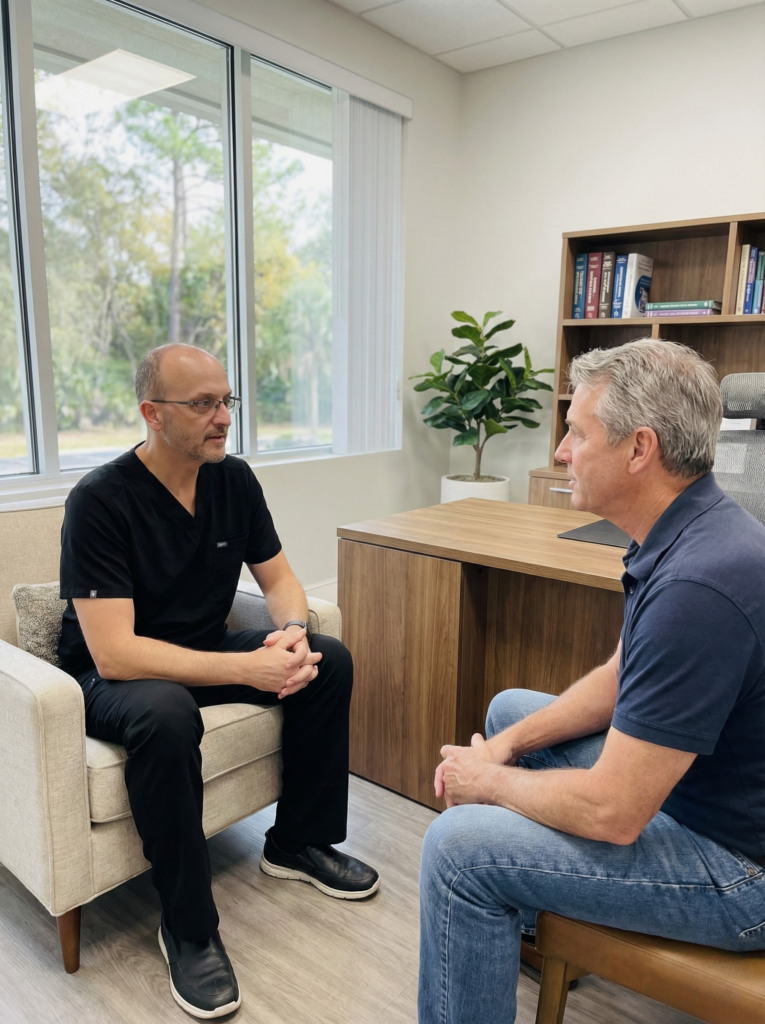
Before we ever discuss treatment, we evaluate.
That means a comprehensive lab panel. Not just total testosterone, but free testosterone, binding proteins, estradiol, blood counts, metabolic markers, and prostate screening when appropriate.
Numbers alone don’t determine candidacy. Symptoms matter. Context matters. Medical history matters.
If you qualify, we design a treatment plan around you — not a pre-printed protocol.
Most men begin with conservative weekly subcutaneous dosing of testosterone cypionate. We reassess both labs and symptoms after six to eight weeks. Adjustments are made slowly and intentionally.
We do not automatically prescribe aromatase inhibitors.
We do not chase supraphysiologic levels.
We do not escalate unnecessarily.
Our goal is optimization — not excess.


The first changes many men notice are subtle but meaningful.
Libido often begins to return within the first few weeks. Energy improves gradually. Mental clarity sharpens. Workouts feel productive again rather than depleting.
Over several months, body composition may shift. Recovery improves. Confidence stabilizes.
TRT is not a stimulant. It is not immediate. It is not cosmetic.
It is restoration — when medically appropriate.
And it works best when paired with resistance training, adequate protein intake, proper sleep, and metabolic support when needed.
Hormone therapy should never be casual.
We monitor hematocrit, estradiol, lipid markers, PSA when indicated, and blood pressure. Follow-up labs are scheduled intentionally. Conversations remain ongoing.
If something needs adjusting, we adjust it.
If something needs pausing, we pause it.
TRT is long-term therapy for most men. That discussion happens before we begin.
Men actively trying to conceive require a different strategy. Certain medical conditions may preclude therapy. Every case is evaluated individually.
This is medicine — not marketing.


There are online clinics that will ship testosterone after a brief video call. There are national franchises built around high-volume subscriptions.
We are neither.
You are evaluated in person. Your labs are reviewed carefully. Your plan evolves based on real clinical response.
Olympia Aesthetics & Wellness serves Palm Harbor, Clearwater, Dunedin, Tarpon Springs, Trinity, Odessa, and the greater Tampa Bay area with physician-guided hormone optimization grounded in safety and long-term thinking.
For some men, testosterone therapy is the entire solution.
For others, it is part of a broader strategy that may include medical weight loss, peptide therapy, metabolic evaluation, or cardiovascular risk management.
We look at the full picture — not just one number.
The goal is not simply higher testosterone.
The goal is sustainable vitality.
Low testosterone can present gradually and may include decreased libido, fewer morning erections, fatigue, reduced muscle mass, increased abdominal fat, brain fog, irritability, and slower workout recovery. Symptoms alone are not enough for diagnosis — laboratory confirmation is required.
Most laboratories define low total testosterone as below approximately 300 ng/dL, but interpretation depends on age, symptoms, free testosterone levels, and binding proteins like SHBG. Treatment decisions are based on both laboratory data and clinical presentation.
Many men notice improvements in libido and energy within two to four weeks. Strength gains and body composition changes typically occur over several months when combined with resistance training and proper nutrition. Full physiologic stabilization may take three to six months.
When prescribed appropriately and monitored with regular lab work, TRT is generally safe for qualified candidates. Monitoring typically includes hematocrit, estradiol, lipid markers, and PSA when appropriate. Individual health history always matters.
Current research suggests that properly monitored TRT in appropriate candidates does not increase cardiovascular risk and may improve certain metabolic markers. Risk depends on overall health profile and pre-existing conditions, which is why medical supervision is essential.
Testosterone therapy can suppress sperm production and reduce fertility. Men who plan to conceive should discuss alternative or adjunctive strategies before starting treatment.
provider-led TRT at Olympia Aesthetics & Wellness typically starts at $187 per month, which includes testosterone medication, injection supplies, follow-up consultations, and ongoing laboratory monitoring. Our pricing is transparent and comprehensive, with no hidden fees. Initial consultation and baseline labs may have separate fees. We also offer membership options for long-term patients. Contact us at (727) 274-1972 for detailed pricing information.
Online TRT services often use standardized protocols and subscription models. In-person provider-led care includes comprehensive laboratory interpretation, individualized dosing, cardiovascular risk assessment, and ongoing safety monitoring.
Subcutaneous testosterone injections are commonly used and often well tolerated. Many patients find them more comfortable and easier to administer. The choice of injection method depends on patient preference and clinical response.
TRT may support improved body composition by increasing lean muscle mass and metabolic efficiency in men with confirmed deficiency. It is not a standalone weight loss treatment, but it can enhance results when combined with proper nutrition and resistance training.
TRT is typically considered long-term therapy. Some men can discontinue treatment, but natural testosterone production may not fully recover depending on duration of therapy and baseline function. This should be discussed before initiating treatment.
Most men respond more consistently to weekly dosing, which helps maintain stable hormone levels and reduce fluctuations. Injection frequency is individualized based on lab response and symptom stability.
Olympia Aesthetics & Wellness provides provider-led testosterone replacement therapy at our Palm Harbor location (33295 US Hwy 19 N #109). We serve men throughout Palm Harbor, Clearwater, Dunedin, Tarpon Springs, Trinity, Odessa, and the greater Tampa Bay area. Unlike online TRT clinics, our program includes in-person physician consultations, comprehensive lab work, and ongoing medical supervision. Call (727) 274-1972 or book online for a confidential consultation.
If you’re questioning whether low testosterone may be contributing to how you feel, the first step is clarity.
Schedule a consultation at our Palm Harbor clinic to review symptoms, labs, and candidacy
Olympia Aesthetics & Wellness
33295 US Hwy 19 N #109
Palm Harbor, FL
(727) 274-1972
provider-led Testosterone Replacement Therapy for men throughout Tampa Bay.
This page is for education and is not a substitute for medical advice. Treatment decisions are made with your provider.

Contact information is for the sole use of
Olympia Aesthetics & Wellness and will not be redistributed.
Olympia Aesthetics & Wellness
33295 US Hwy 19 N #109
Palm Harbor, FL 34684
(727) 274-1972
Get directions
10 am – 6 pm Monday
10 am – 6 pm Tuesday
10 am – 6 pm Wednesday
10 am – 6 pm Thursday
10 am – 6 pm Friday
10 am – 2 pm Saturday
10 am – 2 pm Sunday
Accessibility: Olympia Aesthetics & Wellness is committed to ensuring our website is accessible to all users. If you experience any difficulty, please contact us at (727) 274 – 1972 or olympia@olympiaaesthetics.com. Click for more details